

Virginia International Raceway
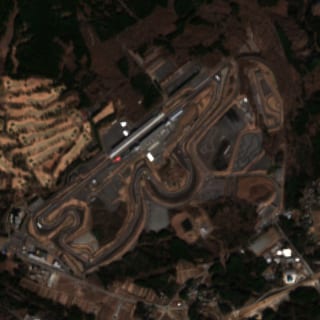
Virginia International Raceway opened on August 3, 1957 on rolling farmland at Alton, Virginia, near Danville. After decades dark, the land spent years as cow pasture, the circuit was painstakingly restored and reopened in March 2000, and today ranks among the finest road courses in the United States. The Full Course runs clockwise for 3.270 mi (5.262 km) over seventeen turns, with about 130 ft (40 m) of elevation change and straights of 3,000 and 4,000 feet linking a lap of blind crests and sweeping, connected bends.
The Climbing Esses
VIR’s identity is the Climbing Esses (Turns 7–9), the signature sequence and, by common account, the most exciting feature of the course. The cars climb the hillside through a rapid run of alternating bends, each cresting near its apex so the car goes light over the rises: a section that rewards rhythm, minimal steering input over the hilltops and absolute trust in the camber.
Oak Tree, the Roller Coaster and Hog Pen
Turn 11 is still called Oak Tree for the lone oak that stood on its outside until it was removed in 2012; the corner feeds the long back straight, making it one of the most important on the lap. The Roller Coaster (Turn 14) crests a hill and is often likened to a scaled-down mirror of Laguna Seca’s Corkscrew, while NASCAR Bend (Turn 3), a tricky decreasing-radius left, carries its name from the trouble it gave Richard Petty, David Pearson and Wendell Scott in a 1966 Trans-Am race. The lap closes through the Snake and the fast downhill Hog Pen (Turn 17), the final right-hander that fires the cars back onto the front straight.