

Watkins Glen International
Watkins Glen International opened as a permanent circuit in 1956 above the village of Watkins Glen in New York’s Finger Lakes region, the successor to the street races that had run on public roads there since 1948. Laid out with help from the Cornell Aeronautical Laboratory and engineer William Milliken, “the Glen” became the home of the United States Grand Prix from 1961 to 1980 and is now owned by NASCAR.
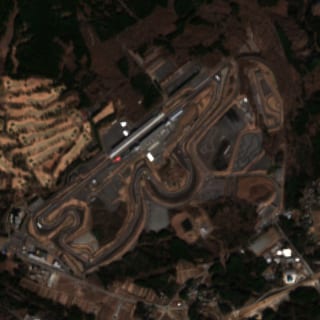
This is the Long Course: the endurance “Boot” configuration. It measures 3.450 mi (5.552 km) over eleven turns, with roughly 41 m (135 ft) of elevation change, and is the layout used by IMSA’s 6 Hours of the Glen. It differs from the Short Course (used by the NASCAR Cup race) by adding the wooded four-turn Boot extension built for 1971; the Inner Loop “bus stop” chicane that defines the modern circuit was added in spring 1992.
The Esses and the Outer Loop
From the heavily banked downhill right of Turn 1, “The 90”, the lap climbs through the Esses, the fast, uphill right-left-right sequence that is the corner the Glen is best known for: the middle left crests blind over the brow of the hill, carried near flat-out and rewarding a driver who keeps the car settled as the camber rolls beneath it. The long back straight follows, broken late by the 1992 Inner Loop “bus stop” chicane, before the long, steeply banked right of the Outer Loop, NASCAR’s Carousel, sweeps the cars downhill into the Boot.
The Boot
The Outer Loop drops the cars down the Chute, a steep downhill left, into the Boot itself: the wooded four-turn extension built for 1971. The near-180 of the Toe of the Boot climbs hard out of the trees to the slower right of the Heel, where the extension rejoins the original circuit. A quick left out of the Boot and a fast left at Turn 10 lead to the final right of Turn 11, its exit wall close enough to concentrate the mind, releasing the cars onto the main straight.