

Suzuka International Racing Course
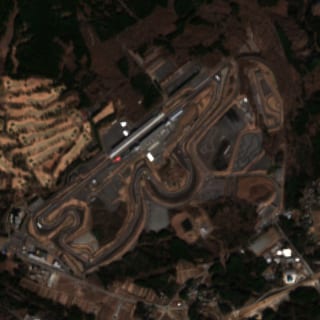
Suzuka opened in 1962 near the city of Suzuka in Mie Prefecture, built by Honda as a test track and designed by the Dutch architect John Hugenholtz, who also laid out Zandvoort. Its Grand Prix configuration measures 3.608 mi (5.807 km) over eighteen turns and runs clockwise, but its defining trait is geometric: it is the only figure-8 layout in Formula 1, the 1.2 km back straight crossing over the front of the circuit on an overpass. That crossover, the constant changes of elevation, and a rhythm-driven flow of corners have made it one of the most respected drivers’ circuits in the world.
130R
The corner Suzuka is most feared and admired for is 130R at Turn 15, a long left-hander at the end of the back straight taken at well over 300 km/h in a modern Formula 1 car. Named for its original 130-metre radius and reprofiled into a two-part radius for 2003 on safety grounds, it remains a near-flat-out test of commitment where lap time and courage are the same thing.
The Esses and the Spoon
The first sector is dominated by the uphill S Curves (Turns 3–6), a flowing left-right-left-right sequence where a single connected line through every apex sets up the whole lap: the rhythm test that drivers prize above all else at Suzuka. The back half of the circuit threads the two blind Degner right-handers (Turns 8–9), passes under the crossover bridge to the Hairpin (Turn 11), and sweeps through the long double-apex Spoon Curve (Turns 13–14) onto the straight that leads to 130R.
A lap of Suzuka
After the fast downhill opening complex at Turns 1 and 2, the Esses climb away to the Dunlop Curve (Turn 7) and the Degners, then the figure-8 crosses over itself into the Hairpin, 200R (Turn 12) and the Spoon. Out of 130R the lap closes with the tight Casio Triangle chicane (Turns 16–18), the last real overtaking chance and the scene of many decisive moments. Andrea Kimi Antonelli set the Formula 1 race lap record here in 2025 at 1:30.965 for Mercedes.