

Spa-Francorchamps
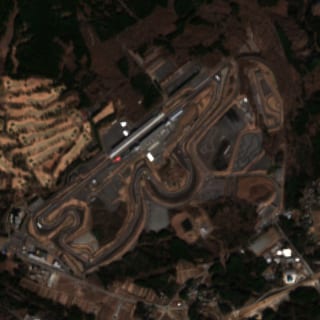
The Circuit de Spa-Francorchamps opened in August 1921, running on public roads through the Ardennes between the villages of Francorchamps, Malmedy, and Stavelot. The original 14.9 km road course has been progressively shortened, most decisively in 1979, when the modern permanent circuit replaced the public-road sections. But the layout retains the elevation, the forest setting, and the high-speed character of the original. The current Grand Prix configuration runs 7.004 km (4.352 mi) over nineteen turns, clockwise, with roughly 102 m (335 ft) of elevation change across the lap.
Eau Rouge and Raidillon
The corner sequence that defines the circuit and, by reputation, the sport. The car drops downhill toward the bridge over the Eau Rouge stream, flicks left at the base, then climbs roughly 40 m (130 ft) through a right-left-right sequence that crests blind. In a modern Formula 1 car the complex is taken flat in top gear at over 300 km/h (186 mph). The 2022 redevelopment expanded the run-off area at the top of Raidillon following a series of high-speed incidents, but did not alter the geometry. The corner still asks the same question it has asked for a hundred years.
The middle sector
After Raidillon the lap settles into a long, fast run through the Ardennes forest. Pouhon, a double-apex downhill left-hander, is the technical heart of the middle sector: the second apex tightens on entry, and the line through both is one long arc rather than two distinct turn-ins. The sequence from Fagnes through Stavelot rewards momentum over outright braking; the laps come from the brake-release timing, not from the brake pedal.
Blanchimont and the bus stop
The final sector returns to high speed at Blanchimont, a long left-hand sweeper taken near flat in top gear with a narrow run-off backed by a steep drop. The lap ends at the Bus Stop chicane, a slow left-right that sets up the run back across the start-finish line and into La Source.