

Portimão
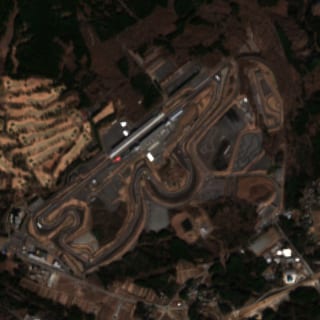
The Autódromo Internacional do Algarve opened in 2008 in the hills above Portimão on Portugal’s southern coast, designed by architect Ricardo Pina. The Grand Prix circuit runs clockwise over 2.891 mi (4.653 km) and fifteen turns, with around 79 ft (24 m) between its lowest and highest points. That constant rise and fall (blind crests, steep climbs and sudden drops packed into a short lap) earned it the nickname the “rollercoaster,” and made it one of the most distinctive modern circuits when it stepped up to host the Formula 1 Portuguese Grand Prix in 2020 and 2021.
The plunge into Turn 1
The circuit’s signature moment is the approach to Turn 1: the long main straight drops downhill into a heavy braking zone, compresses the cars at the bottom of the dip, then climbs away again on the exit of the medium-speed right-hander. It is the best overtaking spot on the lap and the corner where the track’s three-dimensional character is most obvious. Lewis Hamilton set the Formula 1 race lap record here in 2020 at 1:18.750.
Blind crests and the high point
Because most of the corners are unnamed and simply numbered, Portimão is learned through its elevation rather than its landmarks. Turn 4 is a fast left over a blind uphill crest that can unsettle the car; the Turn 10-11 double-right climbs roughly 12 m into a blind entry at the circuit’s high point, then drops some 16 m down the other side, the steepest descent on the lap. The closing sequence works downhill and back up before the fast, undulating final right of Turn 15 releases the cars onto the long straight to begin the plunge again.