

Fuji Speedway
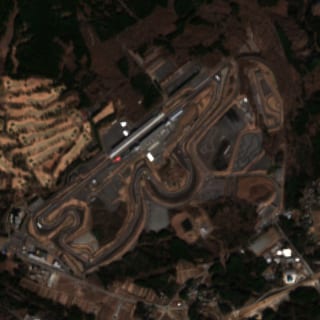
Fuji Speedway sits at the foot of Mt. Fuji in Oyama, Shizuoka Prefecture, and first opened for racing in 1966. The original circuit famously included a steep banked section; after Toyota took ownership the track was substantially redesigned by Hermann Tilke and reopened in 2005 as the modern Grand Prix circuit. That layout runs clockwise over 2.835 mi (4.563 km) and sixteen turns, climbing and falling around the foothills of the mountain.
The main straight and Turn 1
Fuji’s identity is its main straight: at roughly 1.475 km (0.917 mi), one of the longest in motorsport. Cars reach their highest speed of the lap before braking hard for the tight right-hander at Turn 1, now carrying Toyota Gazoo Racing (TGR) branding. It is the circuit’s marquee overtaking zone and its most common accident spot, where a clean exit from the final corner pays off all the way down the front straight.
100R and the fast opening
The early part of the lap flows downhill through the off-camber Coca-Cola Corner and into 100R, a fast, sweeping corner of roughly 100-metre radius that is one of the most respected on the circuit and near-flat in a high-downforce car. The high-speed 300R sweep follows before the lap slows for the infield.
The technical final sector
Where the long straight is all bravery, the closing sequence is all precision: a slow, technical infield through the sponsor-named GR Supra and Dunlop corners winds toward the uphill Panasonic Corner, the medium-speed final right-hander that releases the cars back onto the main straight to begin it all again.