

Menu
← Circuits

United States · Daytona Beach

Daytona

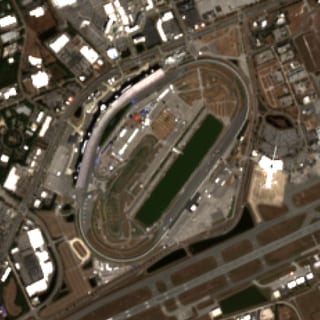
The World Center of Racing: a 3.56-mile road course that threads a tight infield through Daytona's 31-degree superspeedway banking, home of the Rolex 24, America's round-the-clock endurance classic.

Length
5.729 km
3.56 mi
Turns
12
Direction
Anticlockwise
In use
1985-present

Daytona International Speedway

Daytona International Speedway opened in 1959, conceived by NASCAR founder Bill France Sr. and engineered by Charles Moneypenny as a 2.5-mile tri-oval with 31-degree banked turns. The sports-car road course threads a tight infield section into most of that oval: 3.56 mi (5.729 km) across twelve turns, run counterclockwise and essentially unchanged since the infield was revised in 1985. Endurance racing arrived with the Daytona Continental in 1962, a race that grew into the Rolex 24 At Daytona, run around the clock since 1966.

The banking

What separates Daytona from every other stop on the sports-car calendar is the banking. From the exit of Turn 6 the cars run flat-out around the NASCAR oval’s Turns 1 and 2, down the backstretch, and through Turns 3 and 4 (long stretches held at 31 degrees, interrupted only by the Le Mans Chicane) before the 18-degree tri-oval completes the lap past the start/finish line.

The Le Mans Chicane

The backstretch chicane, known for decades as the Bus Stop, is the road course’s signature complex: a left-right entry and right-left exit reached at near-maximum speed. It was widened in 2003 and lost its third leg in 2010, and in January 2022 it was renamed the Le Mans Chicane in a reciprocal gesture with Circuit de la Sarthe, whose first chicane on the Mulsanne Straight became the Daytona Chicane.

The infield

The infield opens with an ever-tightening left-hander at Turn 1, the lap’s prime overtaking spot, and is anchored by two 180-degree right-hand hairpins: the Rodríguez International Horseshoe (Turn 3), which carries the name of Mexican sports-car great Pedro Rodríguez, and the West Horseshoe (Turn 5), linked by the fast left-hand Dogleg. Motorcycles use a modified infield with a tighter hairpin, but the cars’ twelve-turn course is the layout recorded here.

Corner-by-corner

  • T1

    Turn 1

    • Left

    A heavy braking zone at the end of the frontstretch where the cars peel off the tri-oval into the infield through an ever-tightening left-hander; the prime overtaking spot on the road course.

  • T2

    Turn 2

    • Right

    A gentle right-hand kink on the run out of Turn 1, lining the cars up for the braking zone into the Rodríguez International Horseshoe.

  • T3

    Rodríguez International Horseshoe

    • Right

    The infield's defining corner: a long 180-degree right-hand hairpin, reprofiled in the 1985 infield revisions and one of the clearest passing opportunities on the road course.

    Known for decades simply as the International Horseshoe, the hairpin now also carries the name of Mexican sports-car great Pedro Rodríguez, a Daytona favorite of speedway founder Bill France Sr.

  • T4

    Dogleg

    • Left

    A fast left-hand kink on the exit of the International Horseshoe, bending the infield straight toward the West Horseshoe braking zone.

  • T5

    West Horseshoe

    • Right

    The second infield hairpin, a 180-degree right-hander that wraps the cars back around alongside the oval's first banked turn.

  • T6

    Turn 6

    • Left

    The last infield corner, a left-hander that releases the cars onto the oval's 31-degree banking; the speed carried out of here is held flat all the way around to the backstretch.

  • T7

    Turn 7

    • Left

    The first stretch of 31-degree superspeedway banking, the NASCAR oval's Turn 1: a flat-out banked left-hand sweep.

  • T8

    Turn 8

    • Left

    The continuation of the banking through the NASCAR oval's Turn 2, slinging the cars onto the long backstretch toward the Le Mans Chicane.

  • T9

    Le Mans Chicane

    • Left–right

    The entry of the backstretch chicane: a hard braking zone reached at near-maximum speed, flicking left-right off the straight; known for decades as the Bus Stop.

    Added to tame backstretch speeds and reworked repeatedly (widened in 2003, its third leg removed in 2010), the Bus Stop was renamed the Le Mans Chicane in January 2022 in a reciprocal gesture with Circuit de la Sarthe, whose first chicane on the Mulsanne Straight became the Daytona Chicane.

  • T10

    Le Mans Chicane

    • Right–left

    The right-left exit of the chicane, rejoining the backstretch for the short run to the banking of the NASCAR oval's Turn 3.

  • T11

    Turn 11

    • Left

    Back onto the 31-degree banking through the NASCAR oval's Turn 3, taken flat-out.

  • T12

    Turn 12

    • Left

    The final sweep of banking through the NASCAR oval's Turn 4, releasing the field onto the frontstretch and through the 18-degree tri-oval to complete the lap.